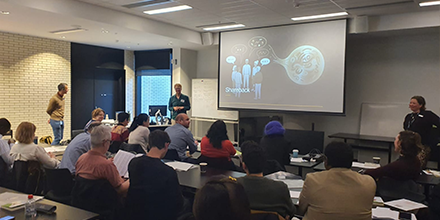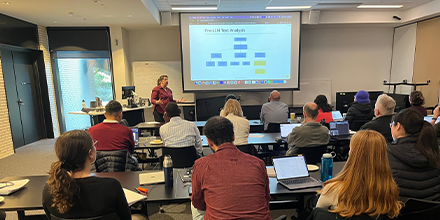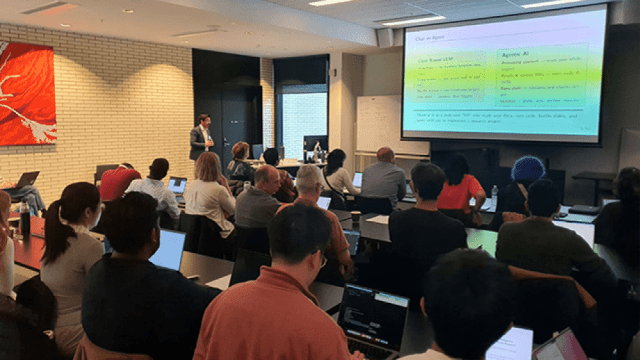
Dr Alessandro Spina during his presentation. Photo courtesy C.Sanhueza (ANU)
On 11 June 2026, the Quantitative Methods Research Group (QMRG) of the Australian Political Studies Association (APSA) held its 3rd Annual Workshop on Quantitative Methods at the Research School of Social Sciences (RSSS) at the Australian National University. The workshop, Integrating AI into Quantitative Political Research, was organised by the group's co-chairs, Dr Thiago Nascimento da Silva and Dr Constanza Sanhueza Petrarca, both of the School of Politics and International Relations (SPIR) at ANU. The event was funded by APSA, with additional support from SPIR. The workshop brought together over 30 participants from across Australia, including early-career researchers and postgraduate students.
The goal of the workshop was to equip political scientists with practical, hands-on skills for integrating artificial intelligence and large language models into quantitative research workflows. Across the day, participants moved from foundational concepts to applied tools, building their understanding from the ground up while reflecting on the methodological and ethical questions that AI raises for empirical research.
The day was structured around three modules led by leading scholars in the field:
- Dr Ben Swift (School of Cybernetics, ANU) opened with LLMs Unplugged, a hands-on session in which participants built and sampled from a simple language model using only pen, paper, and dice, demystifying the core mechanics behind contemporary LLMs without any coding required.
- Dr Alessandro Spina (University of Technology Sydney) then led a two-part session on agentic AI tools for empirical research, demonstrating how AI agents can support data preparation, coding, analysis, and writing, while showing participants how to verify outputs and manage risks such as hallucinated citations and data privacy.
Dr Seraphine Maerz (University of Melbourne) closed with an introduction to Quallmer, an open-source R package for LLM-assisted text analysis, walking participants through a transparent, reproducible workflow for coding large text corpora and validating results against human-coded standards.
This subject matter could not be more timely. Artificial intelligence is rapidly reshaping the way political scientists generate, collect, analyse, and interpret empirical evidence, creating new opportunities alongside new methodological challenges.
Image Gallery