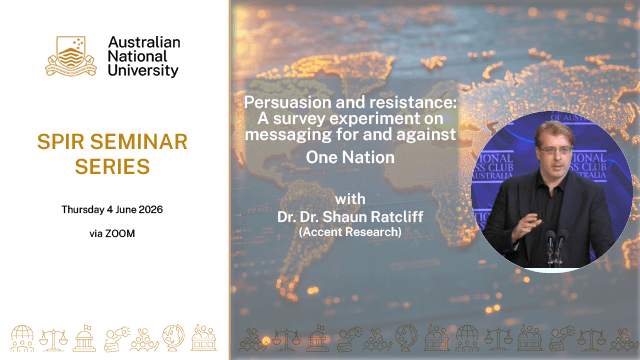
Since the May 2025 federal election, One Nation's primary vote has risen sharply across published polling. If an election were held today, it would likely be the second-largest bloc in the House of Representatives. What drives this surge — and what, if anything, suppresses it — remains contested, with explanations ranging from economic grievance and cultural backlash to anti-establishment disaffection. While these accounts have been tested experimentally for radical-right parties abroad, they remain largely untested in Australia. We evaluate the persuasive power of competing narratives using a 9-arm survey experiment on a nationally representative sample of 6,008 Australian voters. We find a stark asymmetry: pro-One Nation messages significantly increase willingness to vote for One Nation, while attacks on their competence and credibility largely fail. These findings challenge demand-side theories of populist appeal. First, comparative research predicts that nativism is the core electoral driver for radical-right parties. We instead find that messages emphasising economic grievances are the most effective, and adding nativist content to a baseline populist frame yields no detectable additive effect. Second, our results counter the view that populist support stems from an information deficit. While messages emphasising extremism and One Nation's anti-worker voting record delivered the most novel information, they did not significantly reduce support. The only effective counter-message relied on Pauline Hanson’s relationship with Donald Trump. Finally, treatment effects diverge along partisan lines. Anti-messaging merely reinforces opposition among Greens voters, who already hold the lowest baseline willingness to vote for One Nation. Conversely, messaging emphasising cost-of-living pressures had the largest effects among Labor voters — more than double the effect observed among One Nation's own base. Together, these results suggest One Nation's growth potential runs through economic-grievance appeals rather than nativist ones, with the largest gains available among Labor voters.
Dr. Shaun Ratcliff is a political scientist, survey researcher and applied data scientist. He works on complex social and political research projects, studying how the public thinks and behaves, what influences their beliefs and actions, and ways to engage with them. He has worked on political and public health messaging campaigns, and with not-for-profit organisations and corporate clients. Previously, he was Director of Data Science at YouGov and a Lecturer at the United States Studies Centre at the University of Sydney, where he helped establish the Centre’s survey research program.
Zoom meeting ID: 528 504 2235 - Password: 8675309
Location
Speakers
- Dr. Shaun Ratcliff (Accent Research)
Contact
- Richard Frank